Your Financial Advisor Probably Left This Out
Ask anyone about retirement accounts and you will hear the same two names: 401(k) and Roth IRA. Maybe a traditional IRA if they are feeling thorough.
But there is a third account that quietly outperforms both of them in specific situations. Most financial advisors barely mention it. Your Health Savings Account is a retirement account. Start treating it like one.
HSA vs 401(k) vs Roth IRA: Tax Treatment Compared
| Feature | HSA | Traditional 401(k) | Roth IRA |
|---|---|---|---|
| Tax on contributions | Tax-free | Tax-free | After-tax |
| Tax on investment growth | Tax-free | Tax-deferred | Tax-free |
| Tax on qualified withdrawals | Tax-free | Taxed as income | Tax-free |
| Tax stages that are tax-free | 3 of 3 | 1 of 3 | 2 of 3 |
| Required minimum distributions | None | Yes, at age 73 | None |
| 2026 contribution limit | $4,400 / $8,750 family | $24,500 | $7,500 |
| Early withdrawal restrictions | Medical expenses only (before 65) | Penalty before age 59.5 | Penalty before age 59.5 + 5-year rule |
| After age 65 | Any purpose (non-medical taxed like 401k) | Any purpose, taxed as income | Any purpose, tax-free |
| FICA tax savings | payroll contributions | No | No |
Tax on contributions
- HSA
- Tax-free
- Traditional 401(k)
- Tax-free
- Roth IRA
- After-tax
Tax on investment growth
- HSA
- Tax-free
- Traditional 401(k)
- Tax-deferred
- Roth IRA
- Tax-free
Tax on qualified withdrawals
- HSA
- Tax-free
- Traditional 401(k)
- Taxed as income
- Roth IRA
- Tax-free
Tax stages that are tax-free
- HSA
- 3 of 3
- Traditional 401(k)
- 1 of 3
- Roth IRA
- 2 of 3
Required minimum distributions
- HSA
- None
- Traditional 401(k)
- Yes, at age 73
- Roth IRA
- None
2026 contribution limit
- HSA
- $4,400 / $8,750 family
- Traditional 401(k)
- $24,500
- Roth IRA
- $7,500
Early withdrawal restrictions
- HSA
- Medical expenses only (before 65)
- Traditional 401(k)
- Penalty before age 59.5
- Roth IRA
- Penalty before age 59.5 + 5-year rule
After age 65
- HSA
- Any purpose (non-medical taxed like 401k)
- Traditional 401(k)
- Any purpose, taxed as income
- Roth IRA
- Any purpose, tax-free
FICA tax savings
- HSA
- payroll contributions
- Traditional 401(k)
- No
- Roth IRA
- No
The HSA is the only account that is tax-free at all three stages. That triple tax advantage makes it the most efficient dollar-for-dollar vehicle for healthcare spending in retirement.
The Retirement Problem No One Plans For
Here is a number that should change how you think about retirement: $185,500. That is Fidelity's 2026 estimate for what one 65-year-old retiring this year will spend on health care. It leaves out long-term care. Double it for a couple and you are near $371,000. Medicare does not cover everything. Supplemental premiums, prescription drugs, dental work, vision care, hearing aids, long-term care. These costs stack up for decades.
Most people plan to cover this with Social Security or general savings. Both get taxed. HSA withdrawals for medical expenses do not.
Why the HSA Outperforms for Healthcare Dollars
Think about the path a dollar takes through each account when you need it for a medical bill in retirement.
401(k) dollar: You contributed pre-tax. It grew tax-deferred. You withdraw it and pay income tax at your retirement rate. If you are in the 22% bracket, your $1 of medical spending actually costs $1.28 of 401(k) money.
Roth IRA dollar: You contributed after-tax (you already paid up front). It grew and withdraws tax-free. But you needed to earn $1.28 to contribute that $1 in the first place.
HSA dollar: You contributed pre-tax. It grew tax-free. You withdrew tax-free for medical expenses. Your $1 of spending costs exactly $1. No tax at any point.
Dollar for dollar, no other account matches this efficiency for healthcare spending.
The After-65 Flexibility Play
Here is where the HSA earns its spot in every retirement plan. After age 65, you can withdraw HSA funds for any purpose. Non-medical withdrawals after 65 are taxed as ordinary income, just like a 401(k).
This means your HSA is never locked in. If you stay healthy and do not need the money for medical bills, it works exactly like a traditional retirement account. If you do need it for healthcare (and the odds say you will), it is completely tax-free.
You win either way. Compare that to a 401(k), which is always taxed on withdrawal. Or a Roth IRA, which required you to pay taxes up front. The HSA gives you optionality that neither can match.
The Strategy
The play is straightforward:
- ●Max out your HSA every year ($4,400 individual, $8,750 family for 2026)
- ●Invest the balance in low-cost index funds
- ●Pay current medical expenses out of pocket when you can
- ●Let the account grow for decades
- ●Use it for healthcare costs in retirement, tax-free
Do this from age 30 to 65, and at 7% annual returns, your HSA contributions alone grow to over $600,000. That covers Fidelity's 2026 estimate of $185,500 per person, or about $371,000 for a couple, with room to spare.
The Biggest Mistake: Treating It Like a Checking Account
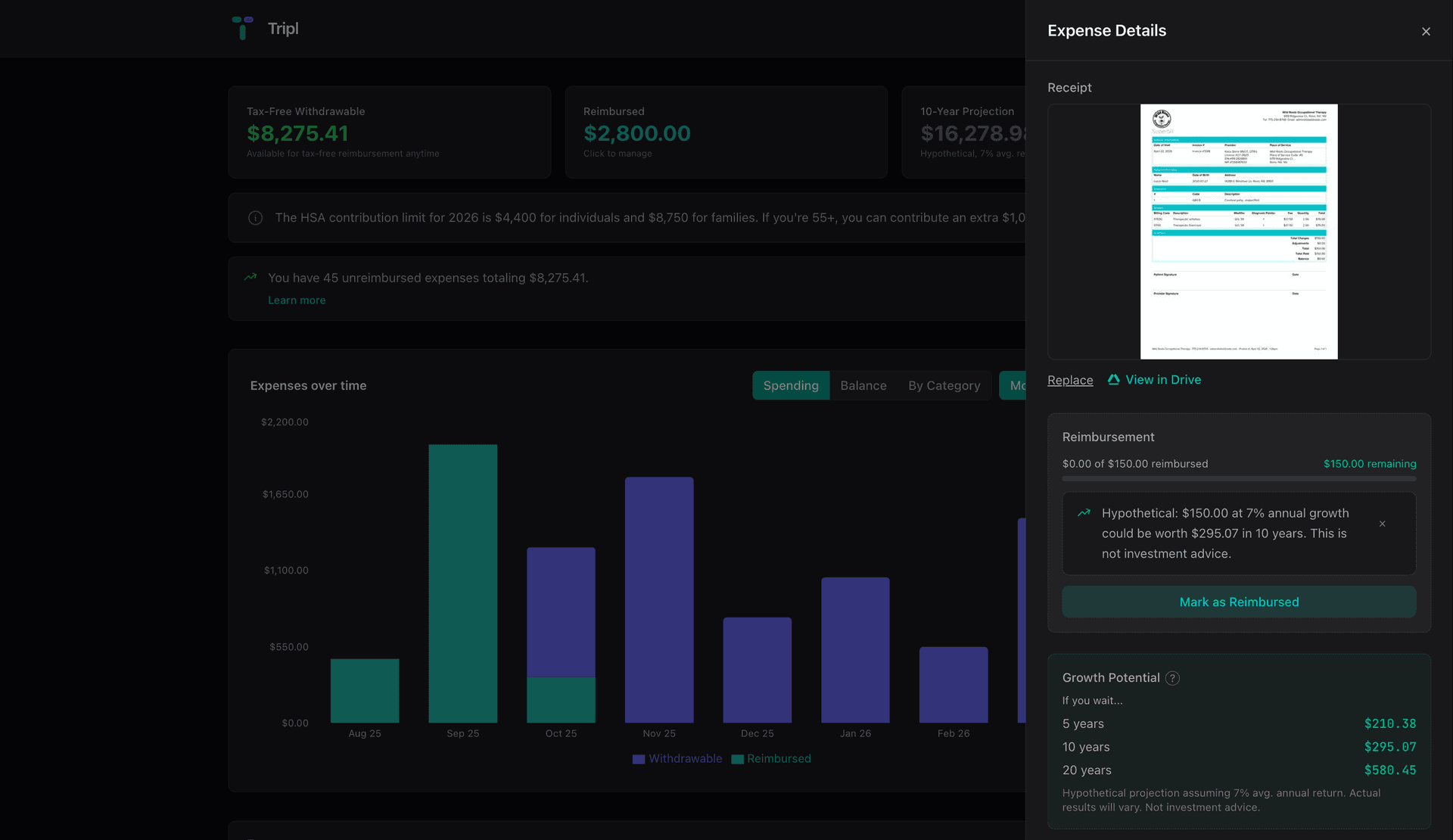
The average HSA balance in America is under $4,000. Most people deposit money, spend it on this year's bills, and never let it grow. They are using a wealth-building tool as a spending account.
You would not pull from your 401(k) every time you had an expense. Stop doing it with your HSA.
The accounts that build wealth are the ones you fund consistently and leave alone. Your HSA should be no different. Stop calling it a savings account. It is a 40-year wealth plan.
*This is educational content, not financial or tax advice. Consult a qualified professional before making decisions about your HSA.*